Sunday, December 25, 2022
The Saints Who Made Christmas: Teresa
Saturday, December 24, 2022
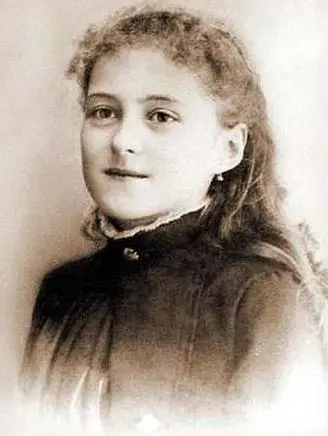
The Saints Who Made Christmas: Thérèse
“Well, fortunately, this is the last year.”
It was Christmas 1886, and the three members of the Martin family had just returned home from Midnight Mass. Mr. Martin and Celine, tired from the strain of being up at such a late hour, were selflessly preparing the parlor for the gift unwrapping as the youngest daughter, Thérèse, hurried upstairs to put her coat away. Thirteen-year-old Thérèse thought that Christmas was going wonderfully until she heard this remark from her sleepy father. Celine bit her lip, knowing if Thérèse was to hear such a comment, it would set her hypersensitive sister off. Peeking around the corner to whisper up the stairs while their father grabbed the treats, Celine addressed her sister.
“You best calm down before coming back to get your surprise,” Celine suggested, trying to look out for both her sister and her father.
Celine disappeared from the staircase, and Thérèse was left alone to sob her heart out, as she usually did when something of the sort happened. She sunk to the ground, the tears forming in her eyes burning them. How could this be the last year?! she thought grumpily. How could Father do this to me?
By chance, the sensitive teenager looked up, and she met eyes with the figure of Jesus, hanging on the crucifix on the wall just upstairs. Crucifixes were commonplace in her home - it was nothing new to Thérèse. But in that moment, Thérèse felt all of her tears recede, and she found herself simply in awe of the self-sacrificing G’D whom she worshiped.
I can be like that, Thérèse thought. I can be like Jesus.
Standing up slowly, Thérèse ran downstairs, setting her coat on a nearby chair. Her shoes were filled to the brim with candy and little gifts. Celine was sitting on the ground by the hearth, and Mr. Martin was just walking into the room from the kitchen, holding a mug of tea in his hands. Upon seeing the face of her father, Thérèse ran up and threw her arms around him, leading him to a chair so he could watch the girls unwrap their many presents. Celine smiled to herself from the hearth, knowing all was well between them. In her own heart, she could sense the change in her sister, and she noticed it persisted all through their unwrapping session.
Celine would later come to understand, through the memoirs of her little sister, what exactly had transpired on the staircase in the early hours of that particular Christmas morning. And Thérèse, through her diary, would touch the world, teaching them to sacrifice their own needs and wants through her Little Way. What began on that staircase would continue on for the rest of her twenty-four years, and not a day would go by in her life as a Carmelite nun in which Thérèse would not thank G’D passionately for allowing her heart to be opened to Him.
Thérèse’s “Christmas Conversion”, as she termed it in her memoirs, is an excellent example to us, future saints, that something so metamorphic can come out of an ordinary circumstance. If Jesus can touch the heart of an 1800s catastrophizer melting with emotion on the stairs of her home, what can Jesus not do for us - or rather, what would He not do for us?
Monday, December 19, 2022
The Saints Who Made Christmas: Clare
“But Sister Annunciata,” Clare protested. “It’s Christmas Eve! No sickness will keep me from the Eucharist!”
“Mother Clare,” Sister Annunciata said gently, “you are so frail. I don’t think you will be able to even get over to the Church. Our Lord understands your sickness and will comfort you here.”
“But Sister-” Clare objected, but Sister Annunciata shook her head.
“Please, Mother,” Sister Annunciata begged. “I don’t want to see you get hurt.”
Clare clasped the wooden rosary beads in her fingers even tighter and sighed.
“Yes, Sister,” Clare agreed. “I will do what you ask.”
Sister Annunciata smiled her bright, Christ-filled smile and kissed Clare on the forehead before closing the door of Clare’s dark cell. Clare laid down in bed, her fingers twisting around her rosary beads. Why must I be sick now? Clare wondered sorrowfully. What could the Lord wish to accomplish with this?
Suddenly, a great light illuminated her room, as if the sun itself had been dropped from the sky and had settled in her cell. Clare threw a hand over her eyes, which were burning from the brilliance. A few seconds later, Clare’s nose began to tingle. There was something…beautiful…in the air. She pulled her hand down and her ears were instantly met with the piercingly beautiful sounds of a choir. In awe, Clare looked around her. The ceilings above her head were vaulted, soaring up to heaven, and there were vibrant colors everywhere. It was the Basilica of Saint Francis, the most beautiful church she knew of - but how was she there?
Unable to answer these questions herself, Clare’s focus was drawn to the marble altar, where the priest was standing, leading the congregation in the Sign of the Cross. Clare made it with him and with the people, forgetting her questions and immersing herself in the mystery of the Mass.
The Mass was absolutely beautiful, and Clare had almost completely forgotten that she wasn’t really there when suddenly, right when the priest passed, everything in the room fell away, and there was only darkness and silence.
At first, Clare was frightened. Where was she? Where was the bright, beautiful church she loved so much? As her eyes focused in the dim light, she began to take in sounds. She could hear the faint lowing of cows somewhere near to her. Her eyes set themselves upon a light a little ways away. Interested, Clare moved closer and stopped dead in her tracks as soon as she saw the people.
It’s just like Francis’ crèche! she thought, her eyes settling on three figures centered in the little cave she had found. There was a man, his fingers clutching the staff at his side, and a young woman, whose eyes were resolutely fixed on the child in her arms. Clare put a hand to her gaping mouth and knelt down, leaning herself against the stones that made up the border of the young couple’s refuge.
Is this what heaven is like? she asked herself. She was perfectly content to sit there and watch her Messiah sit in the arms of his adoring parents for all eternity.
Just as suddenly as the image had come, everything evaporated and there was only darkness. Clare stood up and looked around her. There was no vantage point, nothing for her to grasp - and Clare was afraid.
Clare felt pressure on her shoulder, and instantly she was consumed in a divine peace. Her eyes detected a bright light around her. And turning slowly, she met eyes with her Messiah. He held the Eucharist in His hands, ready to give it to Clare. Tears of joy began to form in her eyes as she dropped to her knees.
........................................................................................................................................................................................
“Mother Clare!” a voice called distantly. “Mother Clare!”
Clare’s eyes opened and she looked around. She was back in her convent in Italy, far from the cathedral, from Bethlehem, from heaven. She took in the sounds of her sisters running up the stairs, excited to see their leader who was too sick to attend Mass with them.
Sister Annunciata burst into the room, followed by Sister Isabella, Sister Lucia, and Sister Ginevra.
Sisters Isabella and Lucia stood around Clare’s bed, while Sister Annunciata placed herself at Clare’s feet and Sister Ginevra knelt on the floor, taking Clare’s hand in her own.
“We really, truly missed you, Mother,” Sister Ginevra said sweetly. “It was such a beautiful Mass.”
“I am so happy you were able to be there, my sisters,” Clare told them with a radiant smile.
“I wish you could have been there too, Mother,” Sister Isabella said. “You would have really loved it.”
“Oh, don’t worry, Sister!” Clare exclaimed, taking sorrowful Sister Isabella’s hand. “Don’t worry. The Lord took care of me.”
Thursday, December 15, 2022
The Saints Who Made Christmas: Francis
Francis had just come to Greccio from a pilgrimage to the Holy Land. It had been a long, exhausting journey of 1984 miles there and 1984 miles back, but Francis had never been more inspired. He considered the journey, no matter how long and perilous it was, to be the most important physical journey of his life, and he had returned to his beloved Italy a changed man. His love for Jesus, especially for the Christ Child, had swelled while visiting Bethlehem, and now Francis wanted to do something to honor the humble earthly beginnings of the Messiah to replicate his life-changing experience for others who could not make the long journey to see Bethlehem.
And so Francis had an idea. Covertly, away from the eyes of the people, he began to prepare a Christmas surprise for them. He found a cave a ways from the city and began to stock it with oxen and donkeys and hay. He crafted a manger and found people to represent the people present at the birth of Christ. Finally, it was ready!
Francis showed his work to his brothers first before sending them out to tell the townspeople of the exciting event that would transpire the next day in the cave outside their town. People were at first confused, but when they heard Francis’ name, they became excited, wondering what the radical friar would do next.
The turnout was exceptional, and as Francis exited the cave from the last-minute preparations, he instantly thanked G’D at the sight of the people, waiting to see. Francis nodded to them, and let them come forward to see his Christmas scene, which he had toiled so hard on. Francis pulled out the Biblical account of the birth of Christ from Saint Luke’s Gospel and began to read in a loud voice, so all could hear and reflect on the incredible event of Christ’s birth.
“Now it happened that, while they were there, the time came for her to have her child,” Francis read, “and she gave birth to a son, her first-born. She wrapped him in swaddling clothes and laid him in a manger because…”
At that moment, Francis paused reading and went to kneel in front of the manger. The people, singing songs of praise, craned their necks in order to see what Francis was doing.
Francis could not believe his eyes. There, in the manger, lay a small child - a baby! - sleeping. Instantly, Francis gently took the child into his arms and began to cry. Everything around him melted away, and to Francis, there was only the Christ Child in his arms.
This Christmas miracle, born from the mind of Saint Francis, is a practice still widely used today. This is the origin of the nativities you see in your home, which are brought forth from boxes and put in prominent places for all to see. So even if you cannot travel to Bethlehem, as many of us cannot, you can still treasure the events that happened there through a scene, carefully replicated from one crafted by Saint Francis just under eight hundred years ago!
Tuesday, December 13, 2022
The Saints Who Made Christmas: Lucy
At the crack of dawn, Kateri opened her eyes, looking around the room. It was a dark winter’s morning and the sun was not yet up. At first, Kateri considered falling back to sleep, mentally groaning at the thought of losing sleep before school. But when her eyes settled on the white robe that was draped over her wooden desk chair, Kateri jumped out of bed with a passion. It was the thirteenth of December, and Kateri had a mission of love that not even the coldest Wisconsin winters could keep her from.
Careful not to wake the sisters that shared her room, Kateri changed from her warm pajamas into the thin white robe that she had set out the night before. Quickly tying a sash around her waist, Kateri grabbed the little wreath from the desk and dashed out of her bedroom on tiptoes.
The oven clock read 5.52am when Kateri arrived at the foot of the stairs. Mother was busy in the kitchen making breakfast for the children to eat before they got ready to go to school.
“Good morning, Saint Lucy,” said Mother cheerily, planting a kiss on Kateri’s cheek. Kateri smiled and looked around the kitchen for the sweet bread she had delicately prepared the night before, long after her younger siblings had gone up to bed. Kateri
went over to the counter and grabbed her tray, piling the little loaves of sweet bread onto it. Mother set a pitcher of hot chocolate onto the tray beside the buns and Kateri added four little mugs. Nodding at the assemblage of warm breakfast treats, she readjusted the wreath atop her head and trekked back up the stairs to the bedrooms of her siblings.
After knocking on the door to the boys’ room, Kateri opened it. The sleepy eyes of her younger brothers, Ambrose and Joseph, immediately lit up as they saw their older sister coming to greet them with breakfast in bed. After serving the boys, Kateri moved on to her own bedroom, where her younger sisters Zelie and Gemma were fast asleep in their bed. Opening the door, light flooded into the room behind her and she went to wake up her sleeping sisters.
“Good morning, guys,” said Kateri with a smile. “I brought you breakfast!”
Zelie and Gemma reached for their early morning treats with squeals of delight. This was what made Kateri want to continue doing it every year - beyond the seemingly everlasting tiredness that was involved in waking up before the roosters, there were always jolly smiles to look forward to, and Kateri would never trade those for the world!
........................................................................................................................................................................................
Can you imagine a time when it was illegal to be a Christian? In a faraway country called Italy, a long time ago, it was. The Italian Christians, however, were a fierce bunch, not afraid of what earthly rulers would do to them if they decided to follow Jesus, so they held Masses in secret and supported each other under cover of darkness. Many Christians were even killed because they believed in Jesus! But even with the threat of death over their heads all the time, the Christians did not stop loving Jesus and sharing the Good News with those who had never heard His name. They were fearless people, unafraid of death, because they knew that death was the way to meet the man they honored more than the most powerful king - Jesus!
One of these fearless people was a young woman named Lucy. She promised Jesus that she would never get married and consecrated her life to the service of the suffering Christians who were in deep trouble with the leaders of their country. When she was only twenty years old, Lucy’s acts of kindness towards Christians in danger were discovered by the government and she was put to death. She died when she was still very young, but she was inspiring to the other Christians, and soon her story spread. Eventually, Lucy became one of the first saints honored by the Catholic Church because of her bravery and compassion for Christians.
One of Saint Lucy’s most famous kindnesses began underground, but eventually spread all over the world. Lucy would bring food and prayers to the Christians hiding underground in the catacombs wearing a wreath of candles to light her way. Now, on her feast day, girls and boys all over the world participate in pageants and processions, or wake up their siblings with warm breakfast treats, just like Kateri’s story!
Even though we are no longer we are not facing death for Jesus in America, we can still look to Saint Lucy as an example for how we should act towards people who are being persecuted. We don’t have to stop celebrating Saint Lucy when the sun sets on her feast day - we can celebrate it all year ‘round through our kind works towards others! Saint Lucy knew Jesus was inside of every person. Let’s follow her example and see people not as objects, but as Temples of the Holy Spirit!
Tuesday, December 6, 2022
The Saints Who Made Christmas: Nicholas
Nicholas was hurrying through the streets of Myra, browsing the town’s handful of shops and markets for vegetables. The kindhearted bishop of Myra knew that in the winter, vegetables were scarce, but knowing that fact didn't stop him from perusing the stands at the market, making sure his suspicions were true.
Nicholas’ eyes caught on a slew of carrots sitting atop a wooden table. He walked over and began to inspect the vegetables under the cautious eyes of the woman manning the market stand. As he was looking the healthy, fire-colored carrots on the table, his ears caught on a conversation going on a few paces over.
“Did you hear about Mustafa’s daughters?” one woman asked. “It looks as though he will have to sell them off, since he cannot pay the appropriate dowry.”
“It was going to happen sooner or later,” the other woman replied with a sigh. “Mustafa has never had much money at all.”
Upon hearing the words of the women near him, Nicholas’ mind fell deep into thought. He knew Mustafa as a good, honorable man, even though he was not a Catholic and did not attend Nicholas’ church. He knew Mustafa would be eternally grieved if his daughters were not with him, especially knowing they were working as slaves. Nicholas’ heart was saddened by the women’s revelation, but he did not know what to do.
“Bishop, are you going to pay for those carrots?” the shopkeeper asked, pulling Nicholas from the world of his thoughts and back onto the chilly Myra street. Nicholas nodded absentmindedly and pulled a pouch full of gold coins from his pocket, extracting one and handing it over to the shopkeeper. As the woman wrapped up the carrots and handed them to Nicholas, he had an idea. What if he were to go to Mustafa’s house and give the money to him?
No, he thought. He didn't want Mustafa to know it was him - Nicholas was a very humble man. As he walked through the winding streets with an armful of carrots, Nicholas pondered how he would deliver the money to Mustafa without the kind man knowing it had been the bishop of Myra. If he left it outside, it might be stolen. He could throw it inside…but there was no guarantee the windows would be unlocked.
Nicholas was deep in thought for the rest of the evening. After a while, he decided to put some coins in a bag and walk over to Mustafa’s house to see if, perhaps, G’D had left a window open for him. Praying all the way, the timid bishop asked G’D to provide a way for him to leave the money safely with the family.
As he approached the house, he peeked through the window. No one was in their living room except for the three daughters, who were sleeping on a cot under the window. He tapped the window to see if it would open, and by the grace of G’D, it did! Relieved, Nicholas looked for a place to drop it. He couldn’t leave it with the girls - they would wake up, and he didn't want them to see him standing there. Nicholas’ eyes caught on their wet shoes, drying off by the fire.
I’ll throw them in there! Nicholas thought. Carefully, he tossed the bag towards the shoes. Nicholas, however, was bad at aiming and instead the bag hit the side of one of the shoes and fell to the ground. The coins spilled loudly out of the pouch, covering the floor with gold. With a gasp, Nicholas hurried to the side of the house so as not to be seen. He heard the sounds of Mustafa coming out of the back room, and the jolly noises of the girls, exclaiming at their good fortune. Happily, Nicholas listened to the sounds of the girls and their father, crying and laughing together at the sight of the precious coins. Nicholas instantly lifted his face to the heavens and thanked G’D for allowing him to help the family in need.
Nicholas’ generous actions have inspired the whole world, both religious and secular, to call Christmas the “season of giving”. Nicholas’ example of generosity can inspire you too on your road to sainthood!
Monday, December 5, 2022
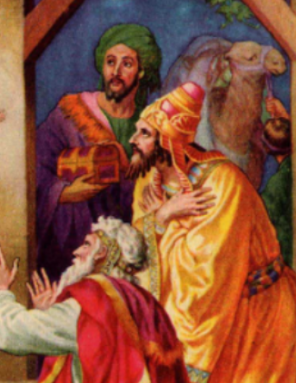
The Saints Who Made Christmas: Caspar, Melchior, and Balthazar
Everyone has seen the Nativity scenes that are commonplace for a wide range of time, sometimes from Thanksgiving weekend until early February! And everyone knows about the Magi, sometimes called the “Wise Men”, who travelled to see the Christ Child because they saw the star and knew it to be a sign of the coming Messiah. We know their gifts to the baby and His parents - gold, frankincense, and myrrh - and we even sing songs about them, such as the ever-popular “We Three Kings”. But even though these wise kings are so standard, I beg to ask - how well do we really know these three men?
In truth, no one truly knows who these three men really were. Their stories are shrouded in mystery and myth, and the only “facts” we know about them really aren’t facts at all, but are more pieces of legends fashioned without a known source.
The names of the wise men come from the names of three kings who ruled at the time of Christ’s birth - Caspar, king of India, Melchior, king of Persia, and Balthazar, king of Arabia. Some accounts claim that they received ordination from Saint Thomas the Apostle and were named bishops. Others state that the three men evangelized all around Europe, Asia and Africa and were eventually martyred for their faith.
Because of their inspirational journey from lands far away to visit the baby Messiah, the Church has honored them with a feast day, Epiphany, which occurs each year on the sixth of January. Epiphany marks the end of the Christmas season. Many Catholic families write the initials of the wise men, surrounded by the calendar year, as a blessing on their home and family.
But in between all the tradition and folklore, there is a much broader question to ask - why were the Magi even there at all?
Take a look at any Nativity scene, any image, any play…you always see the same thing - three crowned men holding gifts, often on the older side, always with different colored skin. Through the mismatched colors of skin, we see a very important message - Jesus did not just come for the Jews! He didn't even come only for the Christians, the poor, or the dirty - He came for everyone, from India to Persia to Arabia and beyond! The importance of the three wise men, so essential to a proper Christmas anything, goes further than the gifts they gave or the crowns they wore - it’s about who they represent and how we should approach the Christ Child. We should come to visit Him in our hearts, making lengthy spiritual journeys, honoring Him with our prayers and immaterial gifts, and remembering that Christ accepts us no matter who we are or where we come from.
Saturday, December 3, 2022
The Saints Who Made Christmas: Joseph
How is this even possible? Joseph thought as he sat on the dusty earth. His deep, chestnut-colored eyes would not leave the gentle figure of his infant god. His strong, carpenter arms seemed to have weakened to oblivion when Mary had carefully laid the child there. Perhaps he had expected a strange force to pulse through him, but instead there was only a weight of seven or so pounds. Or maybe he had assumed a fanfare of trumpets would sound at any second, but the only sound that met his ears were the soft coos of the baby before…silence. Could this really be the G’D of Abraham, Isaac and Jacob, he thought, so unreservedly exposed to the elements He had fashioned with His own hands?
Joseph chuckled to himself as he realized that the only extraordinary thing about the birth was the arrival of filthy shepherds, completely ecstatic, begging to get their hands on the Messiah in between proclamations of a miraculous visitation by a host of angels. Joseph had been skeptical and defensive, wanting to protect both his wife and his LORD from the sullied hands of strangers, but he soon realized his efforts were in vain as his travel-weary wife trustingly passed off the Son of G’D to the wild men. His eyes still darted alertly to the euphoric herdsmen until he felt a hand grab his gently. He looked down at his wife, who was beaming.
“Do not worry, Joseph,” she whispered. “G’D has a plan.”
G’D has a plan, Joseph thought. For an instant, he wondered if G’D really did have a plan. His Son was born in a dirty stable, turned away from every inn, tavern, and private home they went to. Before His birth, His earthly mother had been an outcast in her town, scorned for something they could not comprehend with their human minds. The only guests at His birth arrived late, and they were smeared with dirt and hysterical. He had been wrapped in a single layer of linen and before Joseph had grabbed Him, he had been lying in a manger atop a layer or two of thrice-used hay. How on earth could the arrival of their long-awaited Messiah come under these circumstances? Joseph wondered. How does it even make sense?
Joseph pondered the events for the next hour - the message from the angel, the long journey to Bethlehem, how they were turned away at every inn, the arrival of the shepherds, and now, this ever-so-ordinary silence…could this really be the plan of G’D?
Out of the blue, a thought jumped into Joseph’s head. Maybe it’s not supposed to make sense.
Joseph looked back into the eyes of his king, suddenly understanding how he did not understand. Understanding that his incomprehensiveness was okay. Not understanding the purpose, but knowing whatever the plan for the Messiah was, it would be beyond Joseph’s feeble human imagining.
Joseph looked up through the cave’s opening as the child drifted back to sleep, his eyes settling upon the glittering stars, formed thousands of years ago by the tiny hands currently curled around Joseph’s fingers.
My G’D, Joseph prayed, how beautiful I know Your plans to be. Give me the wisdom to protect this little child, Whom I know will deliver us. Help me to believe in Your plans, even when I do not understand.
Joseph’s eyes returned to his Messiah, peacefully asleep in his arms. It did not seem right, but it was. The plan of G’D was going to be manifested through His Son, a man…and Joseph couldn’t wait to see what happened next.
Monday, March 7, 2022
Our Blessed Friends #8
“A MESSENGER OF HOPE”
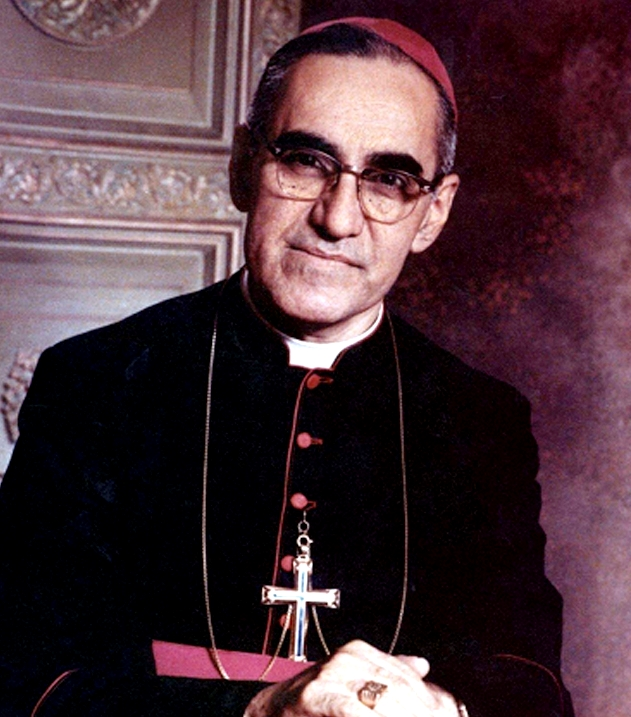
Óscar Romero
Putting the newspaper down on his desk and placing his head in his hands, the tired priest let his mind run wild. He had dealt with harsh criticism, anger, and even threats before, and reading such degrading comments about him in the newspaper was something he was used to, but suddenly he felt something different. Usually, when he read such criticisms in the newspaper, he was able to bounce back quickly, not worrying about what the writers thought of him. He could not recall ever feeling so hopeless. Looking up at the crucifix on his wall, he prayed for courage and for hope. But who was this troubled priest, and why was he being criticized?
Óscar Romero was born on the fifteenth of August, 1917. He went to Rome to study to become a priest and was ordained in 1942, at the age of twenty-four. He was a very dynamic priest who cared deeply for the poor. After serving in San Miguel for over twenty years, he was appointed auxiliary bishop in 1970. He was not as accepted in his role as auxiliary bishop, and it was at that assignment that he had his first taste of criticism.
After spending a brief amount of time serving the people of Santiago de Maria as their bishop, Óscar Romero was appointed Archbishop of San Salvador in 1977.
Óscar Romero used his gifts as a speaker to tell his flock what was going on in the country. He highlighted the cruelty that was commonplace in their society and encouraged reform. He denounced the massacres and the torture and begged the leaders of the country to turn away from their violent, bloodthirsty ways. Speaking on behalf of the poor, Archbishop Romero condemned the evil actions of the government and reminding them “THERE IS A SOLUTION!...WE CAN REBUILD OUR COUNTRY!”
He remained comforting to his people. “AT A TIME OF SO MUCH CONFUSION AND...ANGUISH I ALWAYS WANT TO BE A MESSENGER OF HOPE AND JOY,” Archbishop Romero told them in one homily. And he was. His gentle smile caused all fear to diminish, and his constant repetition of the simple phrase “there is hope” restored people’s hope.
Archbishop Romero displayed the characteristics of a true shepherd - he was brave, loyal, genuine, and he did not care about what those in power thought of him. Bombarded with thousands of lies in the press, the stalwart archbishop never lost his cool. Always keeping his focus on G’D, the archbishop continued to do his job despite all the negative forces that wanted to overthrow him.
On 24 March 1980, at 6.26pm, the archbishop fell before the altar while celebrating Mass. He had been silenced, but as he had once said, he lived on in the hearts of the El Salvadoran people.
Usually in a story, this is where you read, “and the government was so moved by the strength of Archbishop Romero that they reformed their ways, and the country is now free from all past errors”. Sadly, those words are not true in this case. El Salvador is still plagued by destruction. Gang violence is constant, and drugs run rampant. But as the archbishop once said, there is always hope. Archbishop Romero is praying for his people from heaven. We can use our own prayers to pray for the land named for our Savior that was so dear to the archbishop’s heart. And, like Archbishop Romero, let us pray that we too can find the courageous voice inside our hearts so we can speak for the truth.
Monday, February 28, 2022
Our Blessed Friends #7
“G’D IS WITH YOU”
Giulia Gabrieli
A young girl stood alone in the large cathedral, praying. Her hand rested on the tomb of Saint Anthony of Padua. Suddenly, a woman came up behind the young girl and rested her own hand atop the girl’s. Meeting the woman’s gaze, the girl attempted to read the woman’s eyes. “DON’T WORRY. KEEP GOING. G’D IS WITH YOU,” they seemed to say. The girl had never seen the woman before, and she never did again, but her faith had now been strengthened. So who was that girl, and why is this scene important?
Giulia Gabrieli was born into an Italian family in Bergamo in 1997. The oldest of two, she was very good-natured and friendly. She had a lot of hobbies, including writing and music. Her favorite song was the Laura Pausini interpretation of “Strada Facendo” (“Along the Way”). On the outside, Giulia seemed like a very normal girl.
But deep inside her heart, Giulia had a burning love for Jesus. Her faith was tested time and time again near the end of her short earthly life, but she never lost it.
Shortly after being confirmed in 2009, while vacationing with her family, Giulia noticed swelling in one of her hands. When it did not disappear, her parents took her to the doctor, where she was diagnosed with a particularly aggressive form of cancer called sarcoma. The spiritual gifts Giulia had received at confirmation were instantly put to use. At first the treatments were hard for her, and she would find herself in despair, asking “WHERE IS G’D?” But soon, Giulia’s courage was restored, and she was able to continue on with unwavering faith in G’D. This faith was restored on a trip to Padua, where she was reassured by a silent woman that G’D would always be with her.
Through all her pain, Giulia managed to graduate eighth grade with excellent grades. While sick, she put her talents to use and wrote about her experiences. It was published posthumously and titled “A Hook in the Middle of the Sky” - a reference to a line from Giulia’s favorite song.
Giulia also found hope during her illness through two saints she could pray for the intercession of. The first was Our Lady. Her love for her heavenly mother was fostered through two trips to Medjugorje. The second was Chiara Badano, a young girl who had died of cancer in 1990 and had been beatified. Chiara’s story impacted Giulia in many ways, and she found herself replicating the virtues possessed by Blessed Chiara.The love of G’D was always shining through Giulia’s beautiful smile, and everyone around her noticed, even the doctors! The doctors expected Giulia to be sad and depressed, but instead, Giulia was always joyful. When they had to deliver distressing news to her about her condition, Giulia would comfort them, and tell her “superheroes”, as she called them, how wonderfully they were doing their jobs.
Giulia died on 19 August 2011 while the Way of the Cross was ending at World Youth Day in Madrid. Her beautiful example of trust in G’D and thanksgiving for even the simplest of things will always remain relevant!
Monday, February 21, 2022
Our Blessed Friends #6
“IF G’D WILLS IT”
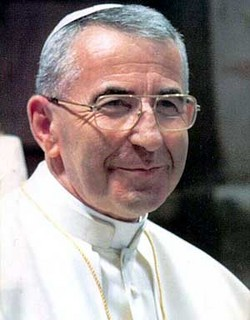
Pope John Paul I
“The pope is dead!” Sister Vincenza cried to Sister Margherita. This, of course, is a very serious claim in the Vatican. He sisters ran to the pope’s quarters and threw open the door. The “smiling pope” wore a smile even in death. His reading light was still on, and he held in his hands a few sheets of paper. This pope’s 33-day reign had come to a silent close. But who was he, and what holy thing had he done?
Albino Luciani was born into a poor family in 1912. When he was in the fourth grade, he decided to become a priest. He began his studies when he was eleven and was ordained when he was twenty-two. His faithfulness to his family remained. Even through his years at the seminary, he returned home annually to help in the fields.
Albino was a very bright scholar. He managed to teach at a notable seminary in Belluno while earning a doctorate in theology in Rome. He was put in charge of religious education in Belluno in 1948 and published a short book, Catechisi in Briciole, or Catechetical Crumbs, for his students.
In 1958, Albino became bishop of Vittorio Veneto. He dealt with a religious scandal while in office. Two priests in his diocese had taken thousands of dollars from the people. Albino made up for it himself.
Albino made many decisive stands, especially after the Second Vatican Council. He spoke on wide range of topics, often focused on
the priesthood. In 1969, Albino was appointed archbishop of Venice.
Albino continued to help the poor and speak out boldly about politics, communism, abortion and divorce, among other things.
Albino was elected pope nine years later. He was titled the “smiling pope”, and anyone who saw him would agree the nickname was perfect. Very jovial and always beaming, it was easy to see that Jesus Christ was the king of his heart. Taking the name John Paul I, he continued to stand up bravely for the teachings of the faith, even though it was overwhelming. He also understood his own humanity, saying, “I AM AT BEST ON THE C LIST FOR POPE.”
On 28 September 1978, the pope died suddenly in his sleep after only 33 days in office. Though his reign was short, as was his life, his resignation to the will of G’D was always strong. “I WILL SEE YOU TOMORROW, IF G’D WILLS IT,” he often said. The “smiling pope” shows that even through a short, quiet life, we can still become saints!
Monday, February 14, 2022
Our Blessed Friends #5
“A MINISTRY OF JOY”
Thea Bowman
As she was wheeled into the hallway, she took a deep breath. Smiling up to heaven - or, to the ceiling that blocked her view - she thanked G’D for the ability to speak. Suddenly, a bishop strode through the door. Putting on a smile, she looked up at the bishop. “Thank you, Sister. You really moved us today,” the bishop said. More bishops began to stream through the door to offer the happy nun their thanks for her words. But who was this jolly nun, and what had she said?
Bertha Bowman was born in 1937 to Theon and Mary Bowman in Mississippi. Both were devoted Methodists. Bertha became attracted to Catholicism through the joyful religious sisters that lived in her town. Bertha’s parents allowed the nine-year-old to convert and enter a Catholic school.
At fifteen, Bertha travelled to Wisconsin to become a Franciscan Sister of Perpetual Adoration - the order of sisters that first drew her to the faith. She continued her education at Viterbo University in Wisconsin and Catholic University of America in Washington D.C. Taking the name Sister Thea, she began to teach students of all ages, reminding them of the love G’D had for the people of every race. She was a brilliant teacher, using the arts to bring them deeper into their studies, as well as traditional African-American teaching strategies.
Sister Thea’s “MINISTRY OF JOY” became more pronounced in the years preceding her death. She gave lectures, performances, and presentations to all kinds of people - including bishops!
Sister Thea’s soul flew to heaven on 30 March 1990, but the mark she left on the world can never be erased. Sister Thea’s holy, joyful display of cultural pride is a wonderful example we can all follow, most especially in our modern world.
Monday, January 31, 2022
Our Blessed Friends #4
“JESUS HAS COME”
Alberto Marvelli
He quietly fumbled with the lock. This one was harder than the others, but still, he managed it. It came off with a click and he looked both ways to make sure he hadn’t been heard. Making the Sign of the Cross, he prayed for the people on the inside of the train, begging G’D for their safety. Opening the door slowly, he reached his hands out to the frightened people. “Come on! We have to hurry!” he whispered. But who was this young man, and what was he doing?
Alberto Marvelli was born in March 1918 to Luigi Marvelli and Maria Mayr as the second of six children. His close knit Catholic family was like a mirror for their faith - they reflected the light of Christ in all that they did. The door of their house was always opened for the beggars. “JESUS HAS COME, AND HE IS HUNGRY,” his mother would always say.
In 1930, Alberto’s family moved to Rimini. There, Alberto began to attend the meetings of a Catholic Action group. He also made time for athletics, which he loved - especially bicycle riding. To foster his spiritual needs, the fifteen-year-old created a rigorous prayer schedule he followed whole-heartedly. As he grew up, Alberto continued to work with Catholic Action (often as its leader), to teach, and to help the poor and infirm.
Alberto became a hero during the second world war through his compassion. Even though they had moved to Vergiano to escape the air raids, Alberto went to the bombed sites and offered the people comfort, prayers, and even his own belongings, right down to his shoes. He also freed Italians and Jews from trains bound for concentration camps.
After the war, Alberto joined the Christian Democratic Party in Rimini and was a very effective leader. He even decided to run for a position in the next election. While on a bicycle going to a meeting, Alberto was hit by a big truck. He died on 5 October 1946.
Alberto was elected posthumously and his mother agreed to take the position. Alberto’s courage, compassion, and faith give us a shining example of what it means to be a truly active Catholic.
Monday, January 24, 2022
Our Blessed Friends #3
“PERFECT ABANDONMENT”
Zelie Martin
Her eyes came to rest on the young man crossing the bridge. Though she had always planned to become a nun like her sister, she had just been turned away. Now, a voice called from deep inside her heart, “THIS IS HE WHOM I HAVE PREPARED FOR YOU.” Suddenly, she knew G’D had a plan for her that was more wonderful than anything she could come up with. But who was this young woman, and what did G’D have in store for her?
Zelie was born to Isidore Guérin and Louise-Jeanne Macé on 23 December 1831 and baptized the following day. She did not remember her childhood fondly, remarking that her childhood in a military family was “DISMAL”. Zelie’s education is attributed to the Sisters of Perpetual Adoration in Alençon. She became a skilled lacemaker while there - a trade which she would continue practicing for the rest of her life.
Zelie met her future husband, Louis Martin, in Alençon and married him in 1858, when she was 26. Originally, she had wanted to enter the convent with her sister, Marie-Louise, but after being turned away, she quickly met Louis and was swept into the blessed life of motherhood.
Zelie bore Louis nine children, four of whom died at early ages. All four of those babies died within three years, leaving Zelie shocked and saddened.
In 1876, Zelie began to suffer from cancer which developed in her chest. She once wrote, asking “IF NOT FOR A CURE, BUT FOR PERFECT ABANDONMENT TO THE WILL OF G’D.”
Zelie died in August 1877, but her legacy continued with her saintly children. The holiness she fostered in her daughters stayed with them, and all five became nuns. Before her death, Zelie’s youngest daughter Thérèse wrote down her Little Way, which seems to have been rooted in her mother’s constant reminders to please Jesus through sacrifice and prayer. Thérèse was later canonized and was named a Doctor of the Church, and another one of Zelie’s daughters, Leonie, is on the road to sainthood. Her other surviving daughters - Marie, Pauline, and Celine - also lived exemplary lives of virtue and may one day be canonized saints. Zelie made sure her husband also made it to heaven, and he is canonized as well. Their loving example proves how our impact on others can make the greatest saints!